
Agreement allows ambulances to cross France–Spain border for all emergency calls in the Pyrenees region
This was signed in Perpignan by the Medical Emergency System (SEM) of Catalonia and the Urgent Medical Assistance Service (SAMU) of France in an agreement covering a 200-kilometer cross-border area in the Pyrenees and guaranteeing a coordinated response to medical emergencies. This is the first agreement between the two countries to improve healthcare assistance. According to the European Commission's Directorate-General for Regional and Urban Policy (DG REGIO), the cross-border movement of ambulances is a common problem in the European Union, and agreements with this level of cooperation have rarely been reached.
This historic agreement represents an unprecedented step forward in healthcare cooperation between Spain and France. It is the direct result of the European project b-solutions ‘When medical emergencies erase borders’, coordinated by the Pyrenees Working Community (CTP). Thanks to it, ambulances will cross the border to intervene wherever the response time is shortest, regardless of the country in which they are located.
'Administrative borders should not be an obstacle when people's lives are at stake'
'This is a tangible example of how cross-border cooperation can improve people's lives and do so through an issue as sensitive as health,' explained Jean Louis Valls, director of the CTP, after the agreement was signed. 'This agreement is a milestone in our journey and purpose: that administrative borders should not be an obstacle when people's lives are at stake,' he highlighted.
In this vein, and with the aim of continuing to remove administrative and legal obstacles, the director of the CTP explained that a total of five agreements will be signed throughout the cross-border territory. The first, signed between the Agence Régionale de Santé (ARS) Occitanie and the Generalitat de Catalunya in November 2025, will be followed by those planned in the medium to long term between Occitanie and Aragon; Nouvelle-Aquitaine and Aragon; Nouvelle-Aquitaine and Navarre; and Nouvelle-Aquitaine and the Basque Country.

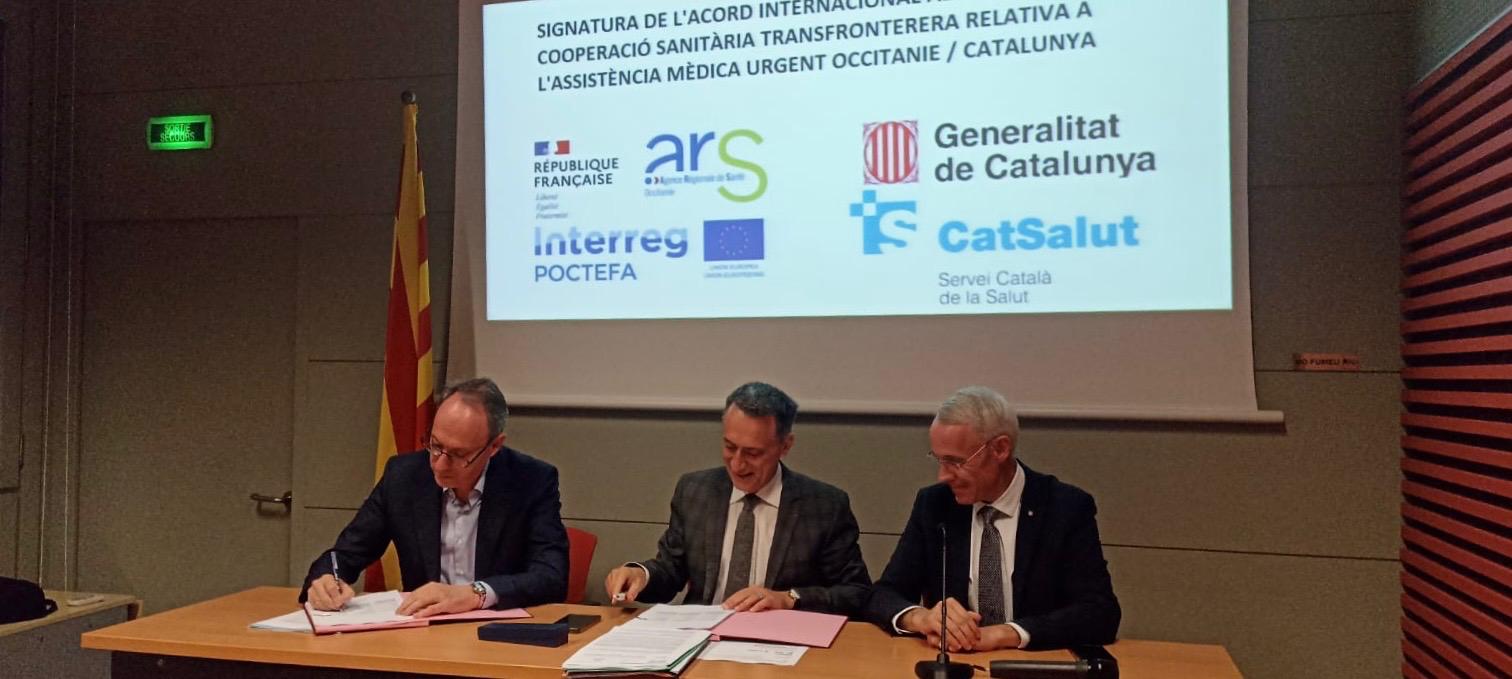
The agreement signed in November includes several technical annexes detailing the mapping of emergency medical services on both sides of the border. These documents also include a description of the resources available in both Catalonia and France (ambulances, medical helicopters and referral hospitals), with the aim of providing a shared and up-to-date overview of the operational healthcare resources.
Joint training and direct communication
The agreement also provides for the joint training of healthcare teams and the creation of a direct communication channel for the immediate sharing of clinical and operational information.
In this way, when an emergency occurs in a border area, the alert will be managed from the country where the incident occurred. Both institutions will then establish two-way communication through the SEM Health Coordination Centre and the SAMU Regulatory Centre. Subsequently, the most appropriate resources will be activated to ensure a rapid and effective response. This will enable the nearest healthcare team to travel to the scene of the incident, regardless of the territory where it has occurred. Finally, the country of origin where the alert was generated will determine the health centre to which the affected persons will be taken.
Support for a hospital that is emblematic of cross-border cooperation
The signing of the Occitanie–Catalunya agreement crowns a process that began more than eleven years ago with the creation of the Cerdanya Cross-Border Hospital (HTC). The HTC, which opened its doors in 2014, is the first and only cross-border healthcare centre in Europe and a symbol of European cooperation in the field of health. These characteristics, and the fact that it is a pioneering centre in combining the healthcare systems of Catalonia and France, have made it a pioneer of European cooperation in the field of healthcare. The healthcare figures recorded in its first decade of operation (up to 2024) demonstrate the importance of its service: 29 403 emergencies; 1,189 surgical operations and 43 749 medical consultations. Since 2014, 127 babies have been born at the cross-border hospital.
The work to make this centre a reality began in 2008, when the Interreg POCTEFA 2007-2013 Programme approved the project that gave rise to the Cerdanya Cross-Border Hospital (HTC), the first European hospital jointly managed by two countries. With ERDF funding of €18.6 million, it was the largest economic project in the history of POCTEFA to date.
In 2018, a new initiative was added to this journey when the CTP presented the European Commission with the b-solutions project ‘When medical emergencies erase borders’, with the aim of improving emergency healthcare in the Pyrenees, an area with around 15 million inhabitants. The b-solutions project was recognised by the European Commission as an example of good practice in cross-border cooperation and, as a result, the agreement signed today was born.
The b-solutions project, promoted by the European Commission's Directorate-General for Regional and Urban Policy (DG REGIO) and managed by the Association of European Border Regions (AEBR), focuses on identifying and addressing the legal and administrative barriers that hinder cross-border cooperation in Europe.
A border that opens up to health
The step taken with the signing of the agreement consolidates the Pyrenees as a European laboratory for cross-border cooperation in the field of health and reaffirms the commitment of the POCTEFA Programme, the Pyrenean Working Community and the health authorities of both countries to a more cohesive, supportive and humane Europe.
What is the Pyrenean Working Community (CTP)?
It is an international consortium whose main objective is to contribute to the development of the Pyrenean massif, taking into account its challenges, preserving its riches and promoting territorial cooperation, in particular cross-border cooperation to improve the lives of the inhabitants of its territories.
The CTP was created in 1983 with the support of the Council of Europe, which aims to provide the Pyrenean area with a cross-border cooperation structure similar to those existing on other European borders. In 2005, the CTP became a consortium, a legal entity subject to Spanish public law, which gave it a new impetus for action, particularly in the field of fund management and the European programmes Interreg VI-A Spain-France-Andorra (POCTEFA 2021-2027), POCTEFA 2014-2020 and POCTEFA 2007-2013.
The members of the CTP are the Pyrenean territories: Nouvelle-Aquitaine, Occitanie, Catalonia, Aragon, Navarre, the Basque Country and the Principality of Andorra.