

Denmark: Hemp house showcases rural bioeconomy potential
Rural districts are a key part of the green transition
’We want to show that rural areas are where the green solutions grow,’ says Mette Jørgensen, Bioeconomy Programme Coordinator in Guldborgsund Municipality.
’The green transition needs green carbon,’ she says, referring to the carbon that living plants accumulate, as opposed to fossil carbon from oil and gas. ’And we can integrate green carbon into the construction industry if rural districts and the building industry make the choice to go for it.’
This notion is backed by science. The CO2 footprint of the construction industry is high and growing. A recent study published in the journal Nature finds that construction-related emissions have doubled in the past 30 years and could double again by 2050. It calls for a ‘material revolution’ replacing carbon-heavy materials like cement with biobased alternatives.
The Interreg North Sea project BBoBB (Building Based on Biobased) is helping the municipality put its vision into action, supported by strong political backing. BBoBB promotes biobased materials in construction and its pilot on Lolland-Falster is focused on Hampens Hus: A house built almost entirely from hemp, including floor, walls, roof, and insulation.

Why hemp?
According to Mette Jørgensen, hemp is ideal in green construction. It can be used for several purposes, including insulation, floors, walls, and roofs.
‘Also, hemp allows diffusion-open construction which does not trap humidity but lets it pass through the wall. So, we can build houses that are both eco-friendly and healthier to live in - with better indoor climate than modern well-insulated houses where you practically live in a plastic bag,’ states Mette Jørgensen.
And hemp offers a range of added benefits, she says. ‘Hemp can also be used for textiles and bioplastics. The seeds are nutritious and can be harvested as well. And farmers like to have it as part of their crop rotation because it takes up the fertiliser very efficiently and ensures higher yields also in the following crop. Growing hemp can even help clean up forever chemicals like PFAS.’
Five points about hemp
Hemp is seen as an eco-friendly building material because it:
At Hampens Hus, hemp is used throughout the building: from walls and insulation to innovative composite materials.
Focus on the value chains
‘With the House of Hemp, we want to show that hemp makes sense as a building material in Denmark. It showcases eight different hemp materials – all imported because there is no hemp industry in this country yet. But we can easily grow hemp here and set up processing companies to deliver Danish-made hemp products for the Danish industry,’ says Mette Jørgensen.
‘By building a house where people can come and see the materials in use, we hope to inspire the entire value chain. A new construction material such as hemp will only catch on if we build interest and capacity in all parts of the value chain.’
She adds that even the municipality itself must be able to handle applications from people who want to build with biobased materials or include biobased materials in its own construction projects. Similarly, she says, Danish educators need to know more about hemp construction, also at the practical level.

Tradition meets innovation
The house is being built at the premises of the local vocational school, UCE (formerly CELF), in Nykøbing, the main city of Lolland-Falster.
The first step was to lay a biobased foundation of seashells and cork and build a timber frame. ’We wanted the house to last at least 100 years, so a solid and sustainable foundation was important. We minimised its CO2 footprint and soil disturbance by using screw foundations from a local enterprise.’
Screw foundations are substantially more climate-friendly than traditional concrete foundations. Also, they are easy to remove at the end of the house’s lifetime leaving the land almost untouched.
The timber frame was cut with robot technology, with the joints carefully designed to minimise the use of screws and nails. This will ease the wood’s recycling once the house has completed its lifecycle.
Expert support from Ukraine
’We are inspired by the Netherlands, Germany, Australia and North America – and above all, by Ukraine where they have built with hemp in the past 20 years,’ says Mette Jørgensen. ’We can grow and build with hemp in Denmark too, so why not?’
To help build the house as well as local competencies, the municipality contracted one of the world’s top hemp construction experts, Ukrainian Sergiy Kovalenkov. He is the co-founder and CTO of the international company Hempire.
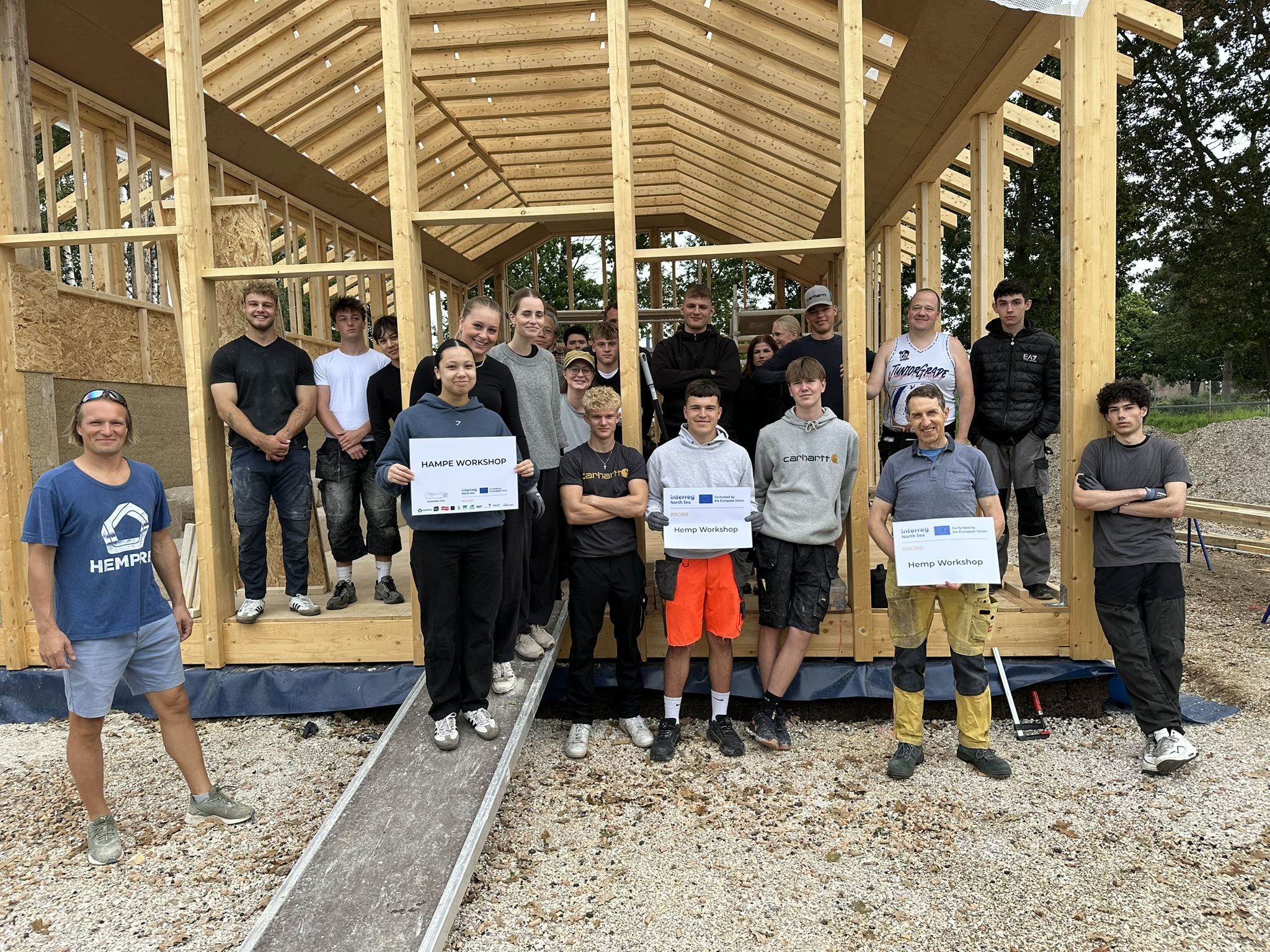
Sergey Kovalenkov spent 10 days leading multiple hands-on hemp construction workshops in Nykøbing Falster. Anyone interested in getting their hands on hemp material had a chance to take part in building the walls of the House of Hemp. The walls of hemp lime were in-situ-moulded.
Although prefabricated hemp lime walls will be the way to go when building on a larger scale, the municipality chose to build the walls manually. ’We made this choice to give as many people as possible the chance to get their hands on hemp material,’ says Mette Jørgensen.
’Some participants want to build their own house, and for this purpose in-situ-moulding is a very good and versatile solution. In-situ-moulding allows almost any shape of a house, including organic and rounded shapes.’

Young people: An asset in the green transformation
Over 90 people joined the workshops, including architects, engineers, constructors, and students from the Danish Technical University (DTU) in Copenhagen and – not least - local students from UCE and the city’s high school.
’The knowledge institutions have a key role to play in introducing new construction materials by educating the next generation,’ states Mette Jørgensen. She highlights the strong enthusiasm among the students. ‘After the workshops, we weren’t quite finished. But some students from UCE’s carpenter line volunteered to complete the task!’

The urban-rural link is crucial
What does it take to mainstream hemp as a green and circular building material? In this video, Sergiy Kovalenkov ventures some proposals for policy changes that would remove unnecessary barriers:

Meanwhile, Guldborgsund Municipality continues its hemp advocacy full speed.
The idea has been brewing for quite some time: ‘In the past 10 years, we have organised the annual Danish Bioeconomy Conference together with leading universities and organisations. We bring stakeholders together who can help build the biobased supply chains in Denmark,’ explains Mette Jørgensen.
It clearly takes time to create a breakthrough, but attitudes are slowly changing, backed by a stronger political focus on bioeconomy at European and national level.
‘The urban-rural link still needs to be strengthened,” she says. ‘Our capital must understand that they can only have a climate-neutral Copenhagen by embracing the green carbon available outside the city walls. Our cities must become a stronger pull factor demanding biobased products from the countryside.’
As such, the hemp house is not just a circular building. It is a house of hope embodying visions of rural-urban harmony, health, and resilience. In short, a bright future also for the rural districts of Denmark.
Header photo: BBoBB project, funded by the Interreg North Sea Programme
Project
BBoBB: Scaling up the biobased economy
The BBoBB project explores the use of biobased materials in the built environment. Its six pilots showcase practical solutions across five countries in the North Sea region.
