

Europe turns to Interreg in a changing geopolitical landscape
Senior representatives from 86 Interreg programmes joined high-level speakers from EU institutions at the Interreg Leaders Forum in Brussels to discuss the future of territorial cooperation after 2027.
Organised by the Interact Programme under the auspices of the Cyprus Presidency of the Council of the EU 2026 and hosted by the European Economic and Social Committee (EESC), the forum focused on how Interreg can respond to Europe’s evolving geopolitical, economic and territorial challenges.
One message resonated throughout the day: in an increasingly uncertain geopolitical context, territorial cooperation is seen as essential to Europe’s resilience, cohesion and future competitiveness. 'Today's geopolitical environment reminds us more than ever that trust is built through cooperation', said Commissioner Raffaele Fitto.
Interreg’s role in a changing political and financial landscape
Discussions throughout the forum highlighted that the future of Interreg is not only a question of funding, but also of governance, democratic participation and the role of regions within the European project.
Several speakers stressed that territorial cooperation has become increasingly strategic in a geopolitical context marked by economic uncertainty, security concerns and growing pressure on public budgets. While acknowledging the need for simplification and stronger performance frameworks in the next Multiannual Financial Framework (MFF), participants warned against reducing Cohesion Policy to a purely financial exercise.
Vasco Alves Cordeiro, Chair of the Committee of the Regions’ Commission for Territorial Cohesion Policy and EU Budget, argued that Interreg helps maintain the EU’s democratic and territorial fabric: 'Interreg reinforces the idea that you need to zoom into the territorial needs to maintain the EU project,' he said, stressing that cohesion policy benefits all regions and remains central to European integration.
The importance of partnership-based governance was also a recurring theme. Elena Calistru, President of the ECO Section at the European Economic and Social Committee, called for stronger involvement of civil society organisations in programme implementation and decision-making processes. 'What we have in Interreg does not need to be changed but scaled up because what we have is already working,' she said, warning against weakening the partnership principle in the future.
The debate also focused on how Interreg can continue contributing to Europe’s broader priorities, including resilience, competitiveness and security, while adapting to a more performance-oriented framework after 2027.
Marcos Ros Sempere, Member of the European Parliament, reaffirmed Parliament’s support for territorial cooperation. 'Interreg will not be under risk', he said.
At the same time, several speakers stressed the importance of preserving Interreg’s experimental and cooperative nature. Rasmus Andresen, Member of the European Parliament, described Interreg as a unique instrument for creating connections between places and people. 'If we didn’t have a programme like Interreg we would need to create it', he said.
Preserving Interreg’s DNA after 2027
A key discussion throughout the forum focused on how Interreg can adapt to new political and performance expectations after 2027 while preserving the cooperation model that has defined the programme for more than three decades.
Hugo Sobral, Deputy Director-General at DG REGIO, stressed that preserving this experimental dimension while ensuring stronger uptake of successful solutions will be essential in the next programming period.
'We often say that Interreg is a laboratory policy, not a delivery tool,' he said. 'Keeping this experimentation dimension of Interreg, and at the same time capitalising on solutions that work and scaling them to mainstream programmes, is the qualitative leap we need to do with Interreg to make it even more meaningful and relevant for the entire EU.'
Building on this perspective, Moray Gilland, Head of Unit at DG REGIO, acknowledged that adapting Interreg to a more results-oriented framework after 2027 represents an important change for programmes.
'From the Commission it looks like evolution, from programme’s perspective it may look like a revolution,' he said, explaining that the focus is increasingly moving towards what programmes achieve on the ground.
Several speakers stressed that Interreg’s added value lies in its flexibility, long-term partnerships and capacity for experimentation. Irene McMaster from the European Policy Research Centre noted that even projects that do not fully succeed can still generate valuable knowledge and lasting cooperation between regions.
Participants repeatedly underlined that future reforms should strengthen Interreg’s impact without losing its DNA as a laboratory of new solutions.

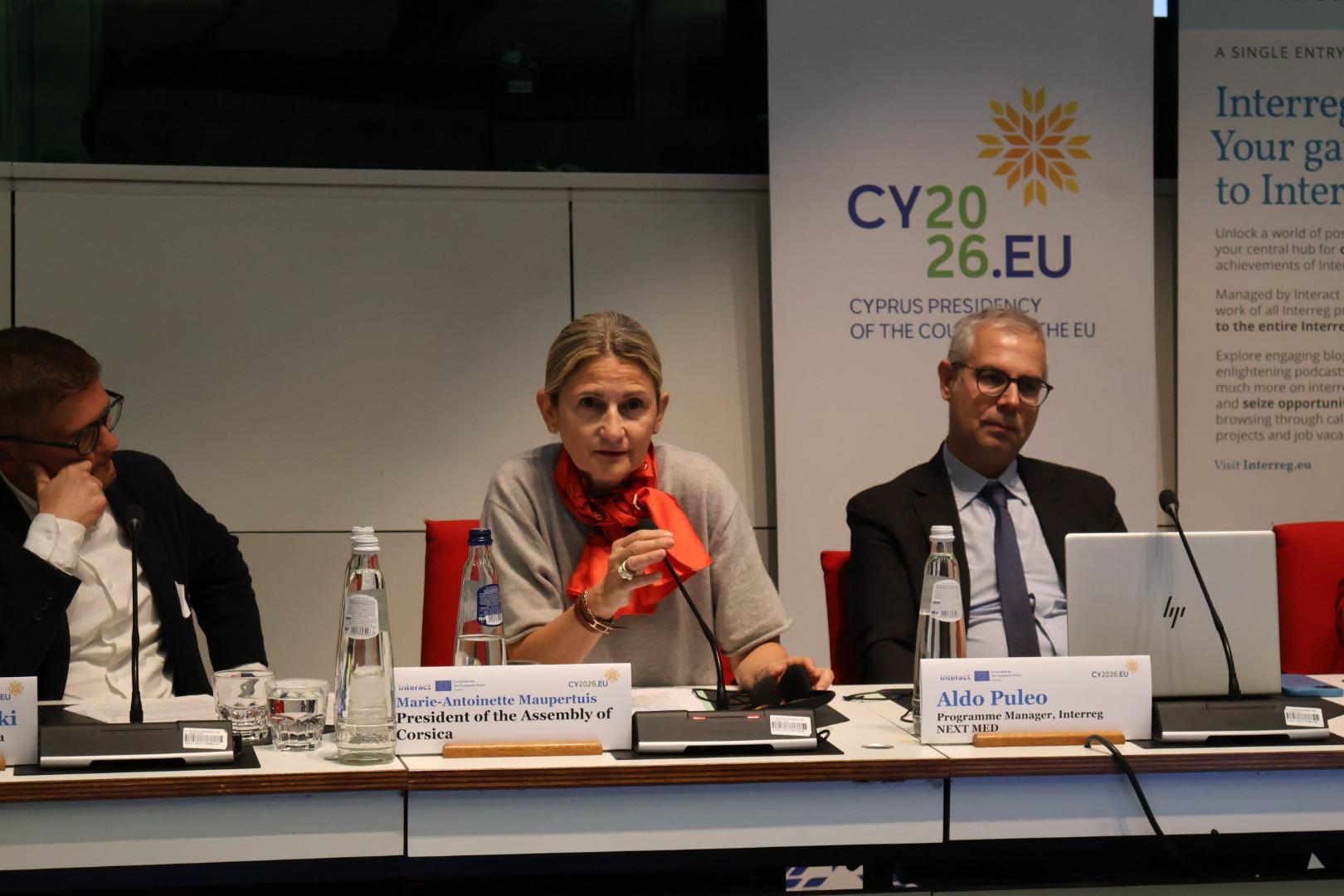
As several speakers noted throughout the day, Interreg’s long-term value lies not only in the projects it finances, but also in its ability to connect regions, institutions and citizens across borders in the long run, turning territorial cooperation into an increasingly strategic tool for Europe’s resilience, cohesion and future competitiveness.
Header photo: Ludivine Porret, Interact Programme.
Related interview
'Interreg creates space for innovation and policy experimentation': Marilena Ayiomamitou
Marilena Ayiomamitou shares the Cyprus Presidency’s perspective on the future of Interreg and territorial cooperation in Europe.
