

How Interreg is equipping France for the hydrogen transition
Europe’s energy independence needs skilled workers
Recent geopolitical and economic pressures have reinforced Europe’s ambition to increase energy independence by expanding renewable energy and diversifying energy sources. Among EU member states, France is no exception, aiming to achieve carbon neutrality by 2050. In this context, hydrogen is one important option, as it can replace fossil fuels in transport and industry in an environmentally friendly way, given that the electricity used in its production comes from renewable energy sources. According to the European Hydrogen Strategy for a climate-neutral Europe from 2020, the EU should be on its way to scale up hydrogen supply from 2% to 14% of its entire energy supply by 2050. While environmentally friendly produced hydrogen holds promise, barriers remain in scaling up production, infrastructure, and workforce skills.
European-level recognition of hydrogen skills is therefore essential, but companies face the challenge of harmonising proof of skills to better verify workforce capabilities – even as the first hydrogen technologies are already being deployed, particularly in the mobility and transport sectors. This is where the projects Green SKHy and HYDEA, supported by Interreg North-West Europe and Interreg Atlantic Area, respectively, come into play.
Green SKHy: Green skills and knowledge for hydrogen
Green SKHy, led by the French professional training organisation Afpa, focuses on building skills across the entire hydrogen value chain, from PhD students to operators. Within the project, partnering universities develop a scheme of transnational summer schools for students, focusing on hydrogen mobility, hydrogen production and its industrial uses. In addition, a mobile hydrogen training lab, developed within the project, offers training in regions where there are no nearby facilities and expertise. The involved training centres across four countries plan to train at least 150 technicians in basic knowledge of hydrogen, hydrogen mobility (trucks, boats, light vehicles, etc.), hydrogen safety and risks, operation and maintenance of hydrogen facilities and more. These practical modules aim to provide experienced technicians with the basic knowledge and skills related to the deployment of hydrogen.

'Our project is being rolled out before certifications and competency frameworks are set in stone. This allows us to intervene upstream and, through regular exchanges between partners and the expertise of companies, to co-develop standards that are better suited to the future of hydrogen', says Clément Maury, lead partner representative of the Green SKHy project.
HYDEA: Boosting the hydrogen transition in Atlantic Area ports
The HYDEA project focuses on preparing the implementation of hydrogen infrastructure in 11 ports across four countries in the Atlantic Area, one of them being the Port of Brest. By joining forces with universities and companies, the involved ports get to analyse the best technologies for the production, distribution, storage, and use of hydrogen in their respective context. A combination of modelling and prototyping activities with techno-economic studies provides a complete set of decision-making tools. Within the project, the Port of Brest focuses on hydrogen production using steam reforming and CO2 capture technologies. The objective is to reduce the cost of hydrogen, which is a major barrier to the market readiness of hydrogen technology. The port is therefore joining forces with private companies (H2X, VERDEMOBIL, GRDF) and regional actors such as the Brittany Region and its development agency Bretagne Next.
'For the maritime and transport sectors in general, the transition to greener energies is a challenge. No actor can achieve it alone. It requires strong cooperation at transnational level to develop green transport corridors and at regional/ national levels to set out a joint action plan adapted to each particular context', says innovation coordinator Fabienne Vallée at the Port of Brest.

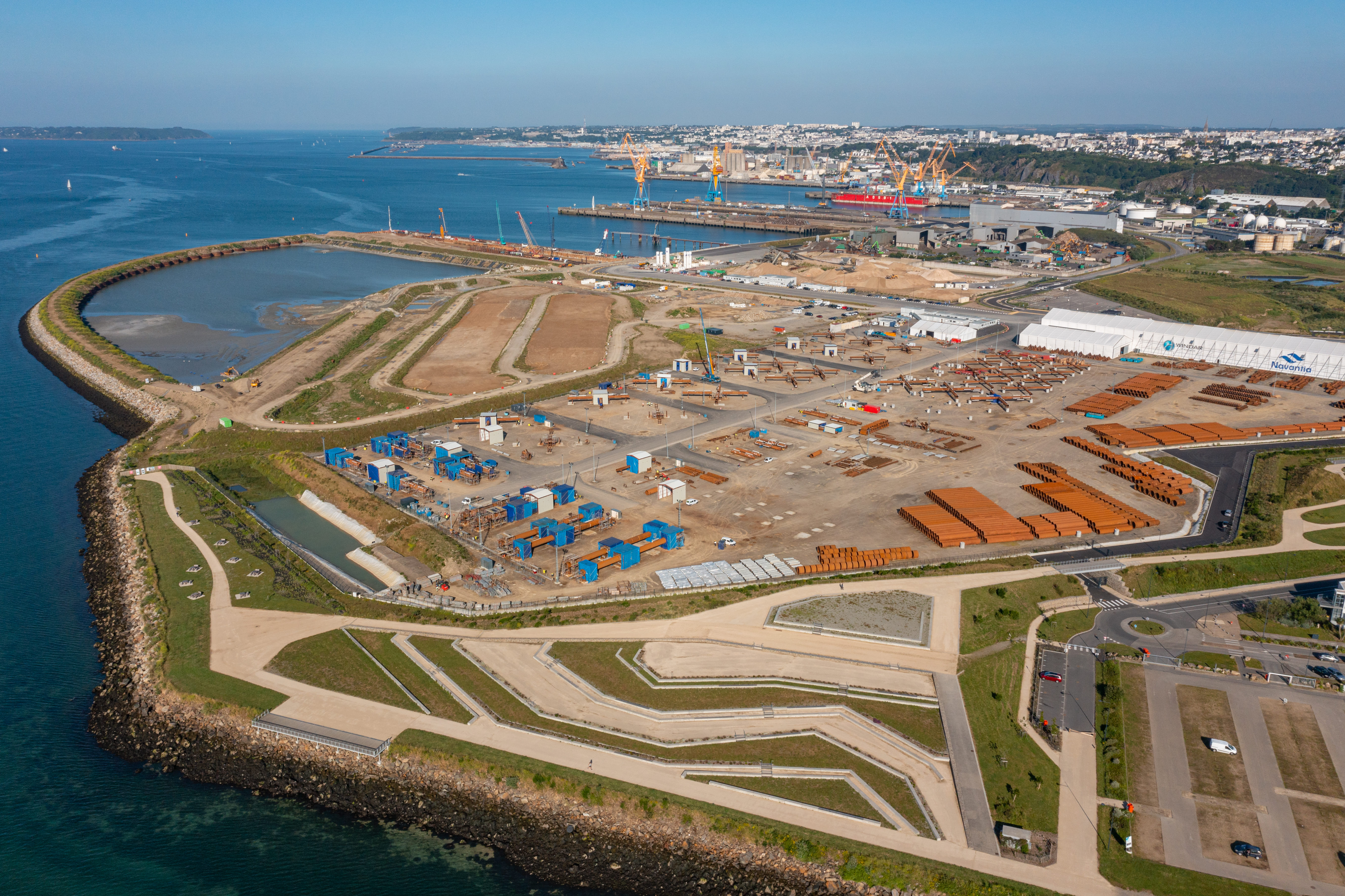
No single port can decarbonise alone
Jean Dubranna from France Energy Marines reiterates that the decarbonisation of port-related activities - as of transport in general - is a huge task requiring significant adaptation of the infrastructure and of port organisation. For a port, developing those adaptations alone is impossible. The HYDEA partnership acts as a transnational applied research and development centre, where ports guide joint studies toward economically viable and practically deployable solutions in their respective port environments.
In the meantime, Green SKHy brought together trainers in the hydrogen field from France, Belgium, Germany and Luxembourg for peer-to-peer training sessions. Afpa trained colleagues from neighbouring countries on how to operate and maintain hydrogen facilities. In return, French trainers learned the basics of hydrogen, hydrogen mobility and industrial decarbonisation from peers in Saarland and Wallonia. By exchanging knowledge in this way, the partners saved development time and jointly checked which training content was relevant and could work across borders. Training centres in all four countries can now deliver this content, helping regions build on each other’s strengths and avoid unnecessary duplication and costs.
One step closer to a hydrogen reality with Interreg
While hydrogen is by no means the single route towards the decarbonisation of transport and industry in Europe, it is an important part of the roadmap. Green SKHy and HYDEA are two of numerous Interreg projects helping to make this vision of hydrogen-fuelled transport - on land and at sea - a reality. Yet this vision can only become a reality if Europe can rely on adapted infrastructure and a skilled workforce enabling providers to work together seamlessly across interconnected transport systems. Fabienne Vallée and Jean Dubranna are helping to lay these foundations in the Port of Brest, Brittany. The same goes for Luc Grimmer and Christophe Ficquet, they will be among the first in France to train certified Hydrogen Installation Technicians, ensuring that the European Union’s hydrogen ambitions are matched by the infrastructure and skills needed to deliver them.
Header photo: In the framework of Green SKHy trainings, technicians are being introduced hands-on to hydrogen technology in vehicles, with Christophe Ficquet and Luc Grimmer joining in the centre (in grey and black jumpers). Photo: Green SKHy.
Series
The local impact of transnational cooperation
This article is part of 'The Local Impact of Transnational Cooperation' series, showcasing the positive effects of transnational cooperation on the ground, one country at a time.
